
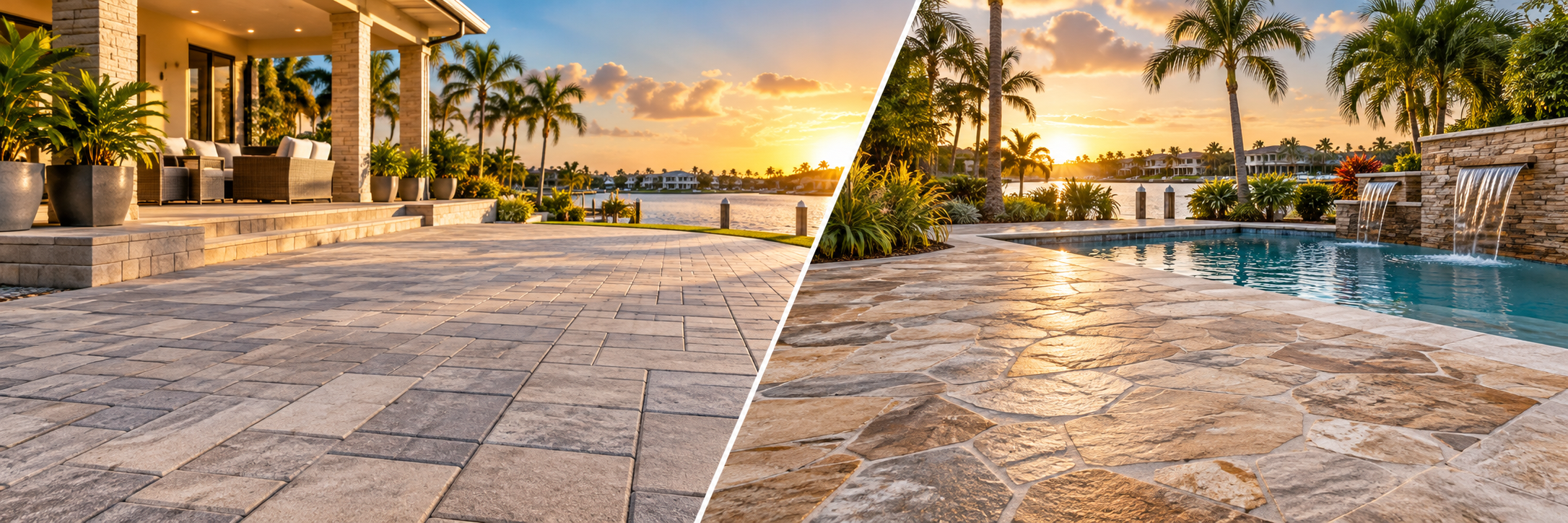
Concrete Pavers vs. Natural Stone: Which Lasts Longer?
Short answer: both last for decades when installed correctly. Dense natural stone can outlive concrete pavers by a wide margin, while concrete pavers give you more predictable strength, lower cost and easier repairs. The right choice depends on where the pavers go and how much you want to invest.
In Clearwater and the rest of Tampa Bay, outdoor surfaces take a beating. Intense UV, summer heat, pool chemicals, salt air, tropical downpours and hurricane-season flooding all test a paver before foot traffic or a car ever does. Picking the material that holds up to those conditions is the difference between a patio that looks new in 20 years and one that needs work in five.
Below, we break down how concrete pavers and natural stone compare on durability, and which one we recommend for driveways, patios and pool decks.
How durable are concrete pavers?
Concrete pavers are manufactured units made from cement, sand, aggregate and color pigments, pressed and cured under controlled conditions. Brands like Tremron, Belgard and Tri-Circle produce them to an industry standard (ASTM C936), which calls for an average compressive strength of at least 8,000 psi and low water absorption. For comparison, a typical poured concrete slab is around 3,000 to 4,000 psi.
What that means in practice:
- Consistent strength. Every paver in a pallet performs about the same, so there are no weak pieces hiding in the layout.
- Flexible system. Interlocking pavers on a compacted base move slightly with the ground instead of cracking like a slab.
- Easy repairs. A stained or broken paver can be lifted and replaced in minutes.
- Typical lifespan: roughly 25 to 50 years with proper installation and basic care.
The weak points are cosmetic more than structural. Surface color can fade under years of Florida sun, and new pavers may show efflorescence, a white haze from natural salts in the cement that usually fades or cleans off. Sealing every few years keeps color richer and resists stains.
How durable is natural stone?
Natural stone pavers are cut from quarried rock: travertine, marble, shell stone, granite, bluestone and flagstone are the most common options for Florida homes. Because nature made them, durability depends heavily on the type of stone and its grade.
- Granite and quartzite are among the hardest paving materials available, often well above concrete pavers in compressive strength. They resist wear, scratching and fading almost indefinitely.
- Travertine is softer and more porous, but a premium, well-filled travertine is very durable for patios and pool decks. It is the most popular natural stone around pools in Tampa Bay.
- Marble is elegant and cool underfoot but softer still, and acidic cleaners or spills can etch it.
- Shell stone (coquina) is a light, local-looking stone that stays cool, but it is porous and needs sealing to resist stains and mildew.
The big advantage of stone is color. The color runs through the whole piece, so it does not fade the way pigment can, and wear tends to add character instead of looking worn out. A well-chosen stone can last 50 to 100 years or more.
The trade-offs: higher material and installation cost, more variation between pieces, and a wider gap between high and low grades. Cheap, low-density stone can chip, flake or absorb water faster than a good concrete paver.
Concrete pavers vs. natural stone: side by side
| Factor | Concrete pavers | Natural stone |
|---|---|---|
| Strength | 8,000+ psi, very consistent | Varies by stone: granite higher, travertine and marble lower |
| Typical lifespan | 25 to 50 years | 50 to 100+ years (quality stone) |
| Color over time | Pigment can fade in strong sun | Color runs through the stone, little fading |
| Heat underfoot | Warmer, especially dark colors | Travertine and shell stone stay noticeably cooler |
| Water and stains | Low absorption; sealing recommended | Porous stones need sealing; granite resists well |
| Repairs | Easy to match and swap | Harder to match exact color and veining |
| Upfront cost | Lower | Higher |
| Best fit | Driveways, walkways, budget-conscious patios | Pool decks, luxury patios, long-term investment |
What Florida weather does to pavers
In colder states, freeze-thaw cycles are the main enemy of pavers. Here in Pinellas and Hillsborough County, the threats are different:
- Sun and heat. Constant UV fades concrete paver pigment over time and makes dark surfaces hot. Light-colored travertine and shell stone stay cooler, which matters on a pool deck in July.
- Pool water and salt. Chlorine and saltwater pools, plus coastal salt air, can wear down soft stone and the surface of lower-quality pavers. Dense, sealed materials hold up best.
- Heavy rain and humidity. Water that sits on or under pavers leads to mildew, algae and shifting. Good slope, joint sand and a well-compacted base matter more than the paver itself.
- Hurricane season. Interlocking pavers on a proper base handle flooding and storm debris well, and individual units can be reset if the ground moves.
Which is better for your project?
Driveways
Concrete pavers usually win. They are engineered for vehicle loads, come in thicker driveway-rated units, and are easy to replace if oil stains or a tire mark shows up. Natural stone can work on a driveway, but it needs a thicker, denser stone and a stronger base, which raises the cost. See our driveway pavers options.
Patios
Both are excellent choices. Concrete pavers give you the most patterns and colors for the budget. Natural stone, like travertine or flagstone, gives a high-end look that ages gracefully and adds long-term value to the home.
Pool decks
Natural stone is our usual recommendation. Travertine and shell stone stay cooler underfoot, offer good slip resistance when tumbled or textured, and keep their color around pool water. If budget is the priority, light-colored concrete pool deck pavers with a quality sealer are a solid, durable alternative.
Installation matters more than the material
The most durable paver in the world will sink, shift or crack if it sits on a poor base. Most paver failures we see in Tampa Bay come from installation shortcuts, not the paver itself.
A long-lasting installation includes:
- Excavating to the right depth for the use (deeper for driveways).
- A compacted aggregate base, built up in layers.
- A level bedding layer and correct slope so water drains away from the home and pool.
- Solid edge restraints so the field cannot spread.
- Polymeric joint sand to lock pavers together and slow weeds and ants.
- Sealing, when the material calls for it.
That is why our paver installation process starts with base preparation that holds over time, whether you choose concrete or stone.
The verdict: which is more durable?
If you want the longest possible lifespan and a surface that ages beautifully, quality natural stone is the more durable investment, especially around pools and on patios. If you want dependable strength, more design choices, lower upfront cost and easy repairs, concrete pavers are hard to beat, and they are the safer pick for driveways.
Many of our clients combine both: concrete pavers on the driveway and travertine around the pool, tied together with matching borders.
Not sure which fits your home? The Novus Outdoor team serves Clearwater, Pinellas and Hillsborough County. We will look at your space, show you real samples of concrete and natural stone, and give you a clear recommendation. Book a free consultation or call us at +1 (813) 344-5150.
Frequently asked questions
Are concrete pavers stronger than natural stone?
Concrete pavers are stronger than softer stones like travertine and marble, but dense stones such as granite are stronger than concrete pavers. Concrete’s advantage is consistency: every piece meets the same standard.
Do concrete pavers fade in the Florida sun?
They can fade gradually over the years. Sealing every 3 to 5 years and choosing pavers with quality pigments slows the process. Natural stone keeps its color because the color runs through the whole piece.
Is travertine durable enough for a pool deck?
Yes. Premium-grade travertine is one of the most popular pool deck materials in Florida because it stays cool, resists slipping when tumbled, and holds up well when sealed.
How long do pavers last?
With a proper base and basic care, concrete pavers typically last 25 to 50 years, and quality natural stone can last 50 to 100 years or more.
Which is easier to maintain?
Concrete pavers are slightly easier: they are less porous than most stone and easy to replace. Natural stone needs periodic sealing, gentle cleaners and, for softer stones, care with acidic products.
Add a comment